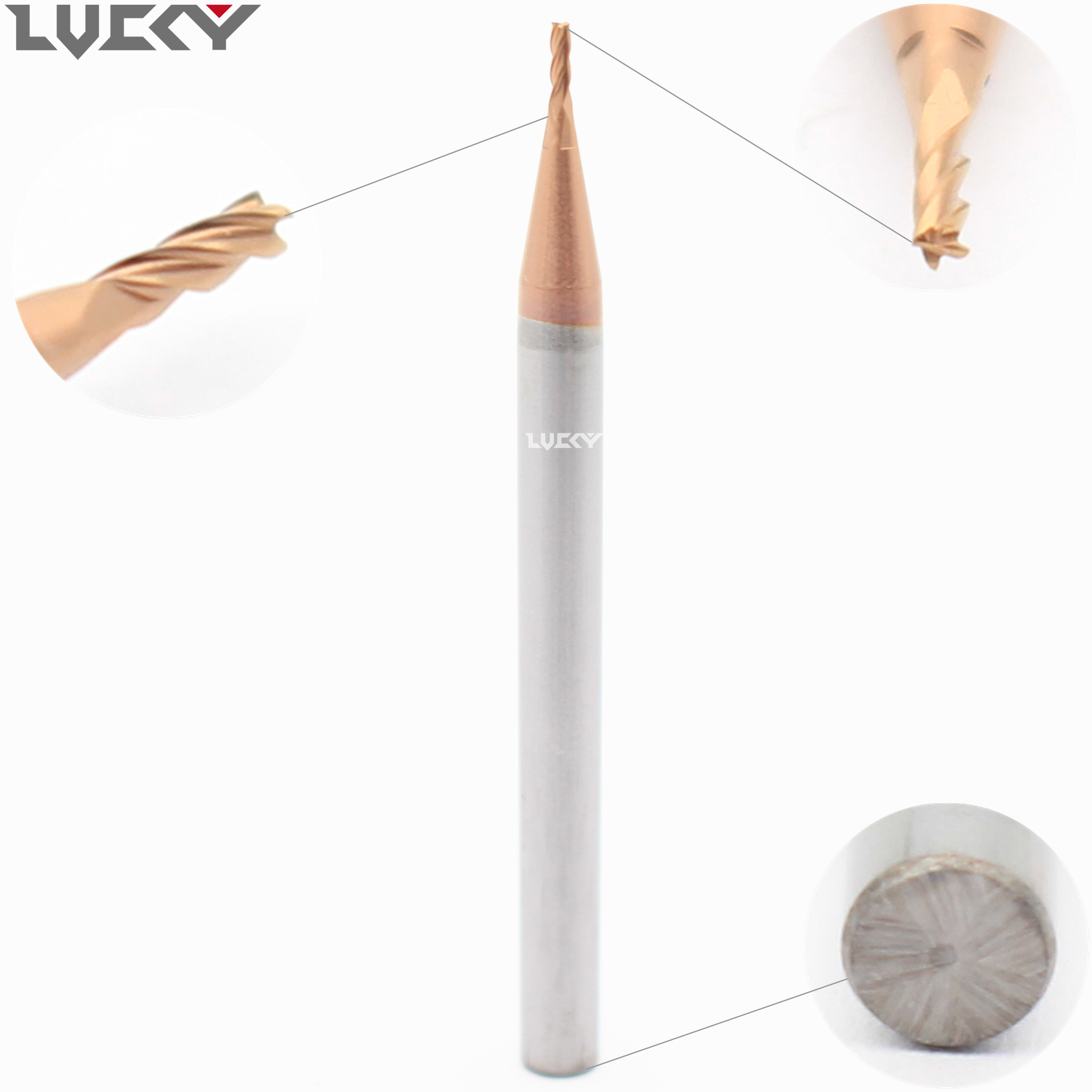
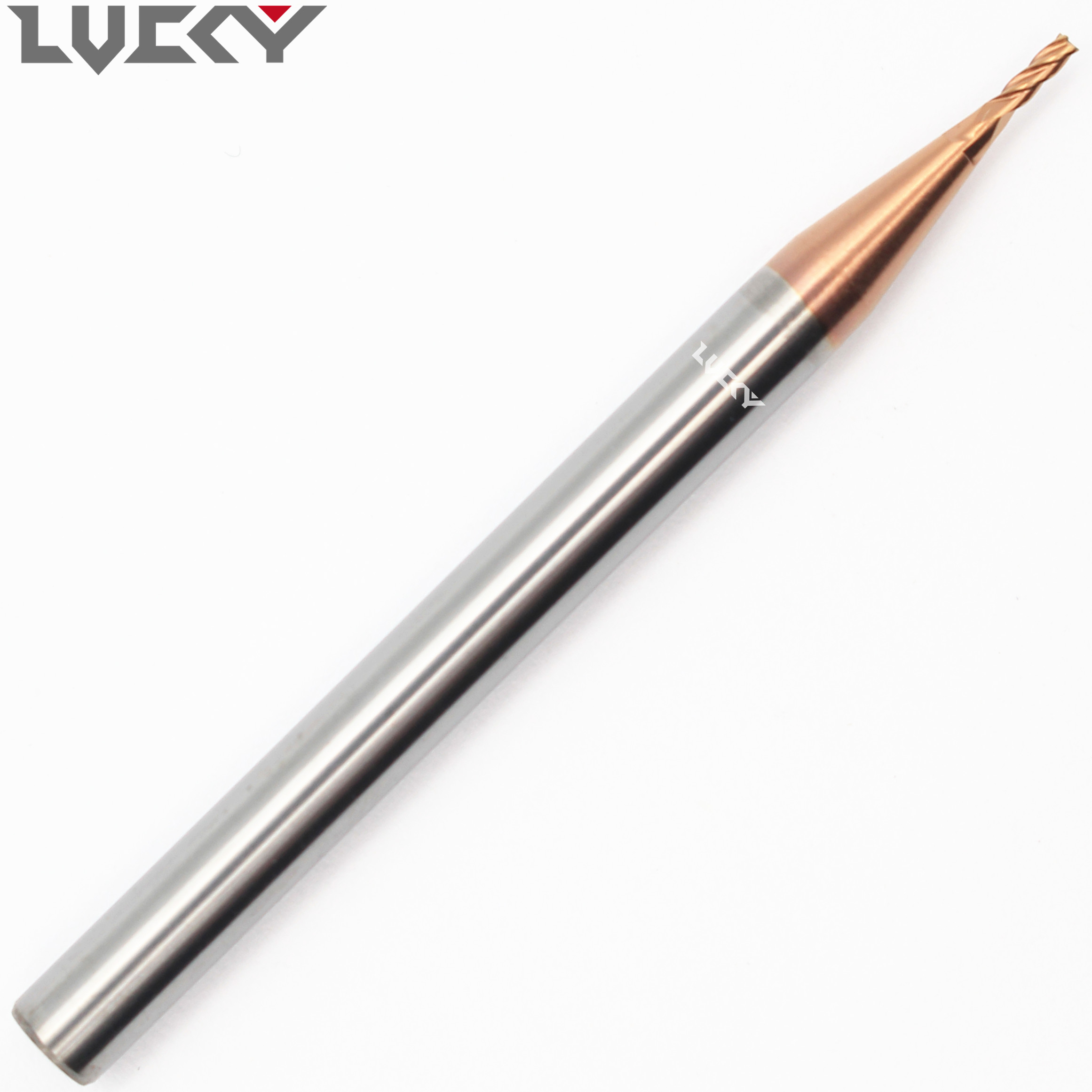
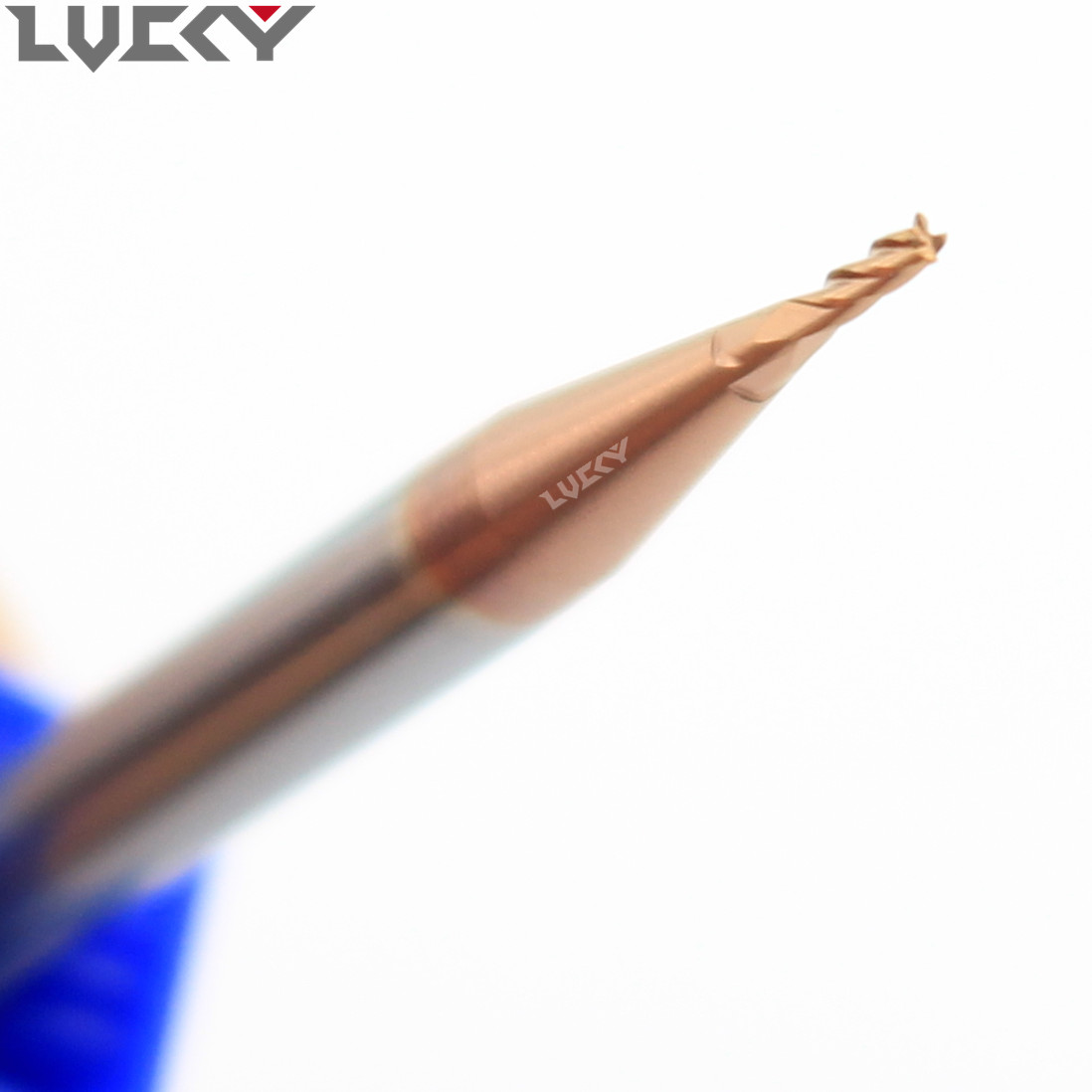

Micro Diameter Solid Carbide End Mill
When your part demands features measured in fractions of a millimeter — micro pockets, tiny slots, fine engraving, or delicate internal corners — ordinary end mills simply cannot reach. Our micro-diameter solid carbide end mill is purpose-built for precision work at the smallest scale, delivering accuracy and repeatability that standard cutters cannot match.
Key Features
- Ultra-Fine Cutting Diameter: Available from Ø0.3 mm down to Ø1.0 mm in 0.1 mm increments. Ideal for micro-moulding cavities, medical device components, electronics enclosures, watch parts, and aerospace instrument features.
- 2-Flute Micro Geometry: Two-flute design maximizes chip evacuation space in the narrowest flute channels, preventing clogging and built-up edge — the most common failure mode for micro tools.
- Tapered Reduced Neck: The precision-ground tapered neck provides clearance behind the cutting diameter, allowing the tool to reach deep into narrow slots, tall ribs, and confined cavities without shank interference.
- Long Length-to-Diameter Ratio: Extended reach variants up to 10:1 L/D ratio available for deep-pocket micro-machining applications.
- Sub-Micron Carbide Grade: Ultra-fine grain carbide substrate delivers maximum transverse rupture strength at minimal diameters — resisting breakage even when the cutting edge is thinner than a human hair.
- TiAlN Coating: Titanium Aluminum Nitride coating provides oxidation resistance up to 800°C and reduces friction at high spindle speeds, extending tool life by 200–300% compared to uncoated micro tools.
- Sharp Corner Radius or Square End: Both sharp-corner (full radius) and true square-end options to suit your corner-radius requirements.
Recommended Applications
Micro-mould and die cavity finishing (injection moulds, progressive dies), medical implant machining (titanium, stainless steel 316L), electronic component manufacturing (copper, brass, aluminium), aerospace instrumentation, watch and jewellery industry, fibre-optic connector housings, and PCB drilling/milling.
Critical Machining Tips for Micro Tools
- Runout is everything. Use high-precision collets (ER16/ER11) or shrink-fit holders. Total indicator runout (TIR) must be under 0.003 mm — otherwise the tool cuts on one side only and breaks immediately.
- Reduce feed per tooth. For Ø0.5 mm tools, feed per tooth should be 0.005–0.010 mm. Never exceed 1% of cutter diameter per tooth.
- Use climb milling only. Conventional milling causes rub-and-bounce that snaps micro tools instantly.
- Full-slot depth of cut should not exceed 0.15×D. For profiling, max DOC is 0.5×D. Peck-cut deep features.
Available Specifications
| Parameter | Range |
|---|---|
| Cutting diameter | 0.3 mm – 3.0 mm |
| Number of flutes | 2 |
| Helix angle | 25° – 30° (reduced for rigidity) |
| Neck type | Tapered reduced / Cylindrical |
| Coating | TiAlN / DLC / Uncoated |
| Shank diameter | 3.0 mm / 4.0 mm / 6.0 mm |
| Overall length | 38 mm – 100 mm |
Cutting Data Reference (Stainless Steel 304, TiAlN)
| Diameter | RPM | Feed (mm/min) | DOC (slotting) | DOC (profiling) |
|---|---|---|---|---|
| 0.5 mm | 25,000 | 50–100 | 0.05 mm | 0.20 mm |
| 0.8 mm | 18,000 | 80–150 | 0.08 mm | 0.35 mm |
| 1.0 mm | 15,000 | 120–200 | 0.10 mm | 0.45 mm |
For aluminium: double the feed. For hardened steel (>45 HRC): reduce speed by 40%.
Manufacturing Quality
Every micro tool is ground on ANCA 5-axis CNC grinding machines with sub-micron positioning accuracy. Each tool passes ZOLLER optical inspection for diameter tolerance (±0.005 mm), runout (<0.003 mm), edge radius consistency, and coating integrity before packaging in individual protective tubes.
Custom diameters, special lengths, non-standard shank sizes, and application-specific geometries are available on request. Standard lead time: 15 working days. Free samples for qualified buyers.