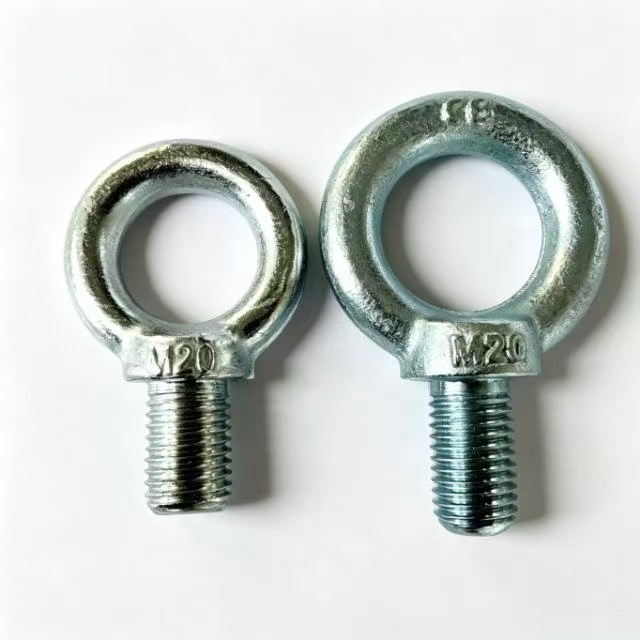
Essential details
Volume:1.2 m³
MOQ:200起订
G.W:1.2 kg
Lead time:1周内
Size:L(6)*W(6)*H(3) cm
N.W:0.045 kg
Product Introduction
GB825 / DIN580 heavy-duty lifting eye bolts are forged fasteners designed for hoisting, lifting, and anchoring loads in industrial, construction, and marine environments. Featuring a robust circular ring head with a reinforced shoulder at the shank root, these eye bolts withstand axial tensile loads and provide a certified lifting point for machinery, molds, and structural components. Available in extended-length configurations and zinc-plated finishes for enhanced corrosion resistance.
Key Specifications
Parameter Specification
Standard GB/T 825 / DIN 580 (equivalent to ISO 3266)
Material Carbon steel (C15, C20), alloy steel (35CrMo, 42CrMo), stainless steel (304/316)
Surface Finish Zinc plated (standard); hot-dip galvanized, black oxide, Dacromet available
Thread Metric coarse (M), full thread
Size Range M6 – M100 (DIN580); M8 – M100 (GB/T 825)
Grade Options 4.8 (standard), 8.8, 10.9, 12.9 for heavy-load applications
Extended Length Available up to 300 mm or custom
Standards & Compliance
GB/T 825-1988 is the Chinese national standard for lifting eye bolts, covering sizes M8 through M100. The standard specifies dimensions, tolerances, materials, technical requirements, and testing methods. Eye bolts must be integrally forged and normalized, with grain size no lower than grade 5, and hardness of HRB 67–95.
DIN 580 is the German standard for lifting eye bolts, technically equivalent to ISO 3266. The two standards share compatible load capacities and structural dimensions, allowing interchangeability in most industrial applications.
Material & Manufacturing
Standard production uses C15 or C20 carbon steel for general lifting applications. For higher load requirements, 35CrMo or 42CrMo alloy steel is available, achieving strength grades of 8.8, 10.9, or 12.9. Stainless steel 304 (A2) and 316 (A4) options provide superior corrosion resistance for marine and chemical environments.
Eye bolts are manufactured using integral forging — a critical safety requirement for lifting components. Small sizes are typically forged in multi-cavity dies, followed by machining for thread formation. Forgings undergo normalization to refine grain structure and eliminate internal stresses.
Load Capacity (WLL — Working Load Limit)
Load ratings below are for DIN 580 / GB825 eye bolts under axial load (0°) with a safety factor of 4:1. Loads at angles are significantly reduced — always consult the load direction table before use.
Thread Size Axial WLL (kg) ≤45° WLL (kg)
M6 75 55
M8 140 100
M10 230 170
M12 340 240
M14 450 350
M16 700 500
M20 1,200 860
M24 1,600 1,200
M30 3,200 —
M36 4,600 —
M42 6,300 —
M48 8,600 —
Source: DIN 580 load capacity table, safety factor 4:1
Surface Treatment & Corrosion Protection
Standard zinc plating provides economical corrosion resistance for indoor and general outdoor use. Hot-dip galvanizing is recommended for extended outdoor exposure or humid environments. Dacromet coating offers superior corrosion protection without hydrogen embrittlement risk, making it suitable for high-strength grades (10.9/12.9). Note: For electroplated high-strength eye bolts, dehydrogenation baking within 24 hours of plating is mandatory to prevent hydrogen embrittlement.
Applications
Lifting points on motors, gearboxes, generators, and compressors
Mold and die handling in injection molding and stamping operations
Marine equipment and offshore structure lifting points
Pressure vessel and tank handling interfaces
Construction — precast concrete panel lifting, steel erection
Wind power — tower section and nacelle lifting
Safety Notes
Axial load only — Eye bolts should be screwed in vertically. An oblique pull up to 45° is permissible, but transverse (side) loads must never be applied.
Fully tighten — The eye bolt must be screwed down until the shoulder contacts the bearing surface. Insufficient thread engagement drastically reduces load capacity.
Do not use tools to over-tighten; hand-tight plus a slight snug is sufficient for proper seating.
Regular inspection — Inspect for deformation, cracks, corrosion, or thread damage before each use. Visibly damaged eye bolts must be scrapped immediately.
Do not substitute — Never use swing bolts (DIN 444) as replacements for lifting eye bolts in hoisting operations.
Temperature range — Standard eye bolts are rated for operation between −20 °C and +200 °C.
Ordering Information
Thread sizes: M6–M100 (GB825 / DIN580)
Extended lengths: Available on request for deep-hole or recessed applications
Materials: Carbon steel, alloy steel, stainless steel (304/316)
Finishes: Zinc plated, hot-dip galvanized, black oxide, Dacromet
Documentation: Mill test certificates, load test reports, and material traceability available
Packaging: Cartons, pallets, or customized export packing


