முக்கிய விவரங்கள்
அளவு:0.32 m³
மொத்த எடை:0.32 kg
அளவு:L(6)*W(6)*H(6) cm
தரவு எடை:0.056 kg
பொருள் விளக்கம்
Product Overview
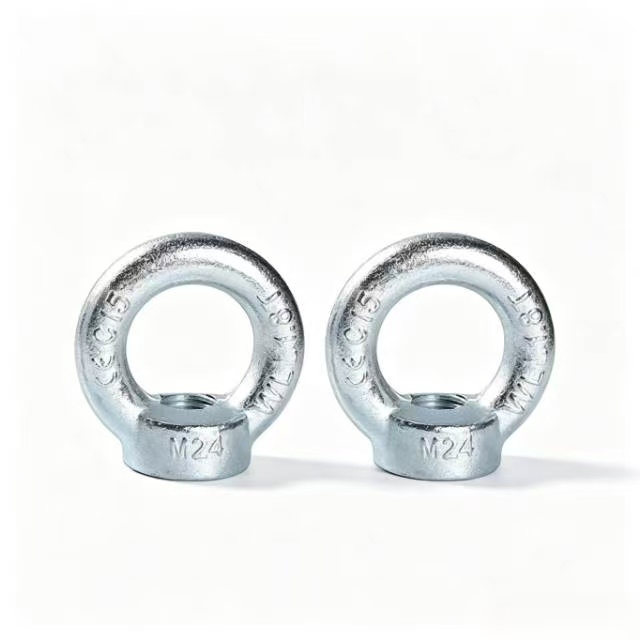
Lifting eye nuts (also known as ring nuts or eye nuts) are forged steel threaded lifting points designed to be screwed onto bolts, studs, or threaded rods to create a secure, certified lifting attachment point. Unlike eye bolts, eye nuts feature a female metric thread, making them ideal for applications where a threaded stud is already present or where the lifting point needs to be installed flush against a surface.
Our lifting eye nuts are manufactured to DIN 582 standard — the German/European specification for forged steel ring nuts used in lifting and load securement applications. They are available in M6 through M16 (with larger sizes available upon request), finished with electro-galvanized zinc plating for corrosion resistance, and are suitable for vertical lifting only (load along the axis of the thread).
Each eye nut is drop forged from C15E carbon steel, providing superior grain structure and strength compared to cast alternatives. They are marked with WLL, thread size, manufacturer code, and CE marking for full traceability and compliance.
Standard & Compliance
Parameter Specification
Standard DIN 582
Material C15E carbon steel (EN 10084)
Safety Factor 4:1 (Minimum Breaking Load = 4 × WLL)
Temperature Range −20 °C to +200 °C
Marking WLL, thread size, grade, manufacturer code, CE
Finish Electro-galvanized (zinc-plated, Cr(VI)-free)
Thread Type Metric coarse thread (right-hand)
The eye nut must be fully screwed in, achieving firm contact between the two mating faces. The counter thread must be of an equal length and the base material of an equal strength to that of the nut. Loading must be applied in the direction of the thread axis — larger angles between slings than 90° are not tolerated.
Types & Sizes (M6 – M16)
Thread Size WLL (t) WLL (kg) d2 (mm) d3 (mm) d4 (mm) e (mm) h (mm) k (mm) Weight (kg/pc)
M6 0.08 80 20 36 20 8.5 18 8 0.045
M8 0.14 140 20 36 20 8.5 18 8 0.05
M10 0.23 230 25 45 25 10 22.5 10 0.09
M12 0.34 340 30 54 30 11 26 12 0.16
M14 0.34 340 35 63 35 13 30.5 14 0.24
M16 0.70 700 35 63 35 13 30.5 14 0.24
Dimension references: d2 = ring inside diameter; d3 = ring outside diameter; d4 = ring inside diameter; e = thread height; h = overall height; k = ring width. Data sourced from DIN 582 technical tables.
Note: M6 and M8 share identical ring dimensions (20 mm inside / 36 mm outside). M14 and M16 also share identical ring dimensions (35 mm inside / 63 mm outside), with M16 offering a higher WLL due to the larger thread engagement.
Product Features
Drop Forged C15E Carbon Steel — Closed-die forging delivers consistent material density, dimensional precision, and higher load capacity than cast or machined alternatives.
DIN 582 Standard Compliance — Meets the dimensional and material requirements of the recognized European standard for lifting eye nuts.
Electro-Galvanized Finish — Zinc plating provides good corrosion resistance for general industrial, indoor, and outdoor applications. Cr(VI)-free passivation for environmental compliance.
Permanent Marking — Each eye nut is permanently marked with WLL, thread size, manufacturer code, and CE mark for traceability and inspection.
Compact Design — The female-thread design allows direct mounting onto existing studs or threaded rods without the protrusion of an eye bolt, ideal for space-constrained applications.
Temperature Stability — Maintains full WLL from −20 °C to +200 °C, suitable for a wide range of industrial environments.
Applications
Lifting eye nuts are widely used across industries including:
Industrial Lifting & Rigging — Creating lifting points on threaded studs, eye bolts, and machinery components
Construction & Infrastructure — Lifting and positioning steel structures, precast elements, and heavy equipment
Mechanical Engineering — Permanent lifting points on machine tools, molds, and fabricated assemblies
Transportation — Securing and lifting during shipping, towing, and load securement
Energy & Utilities — Installation and maintenance of power transmission equipment, wind turbines, and pipeline systems
Marine & Offshore — Deck lifting and mooring point attachment where vertical lifting is applicable
Installation & Usage Guidelines
Ensure full thread engagement — The eye nut must be fully screwed in until firm contact is achieved between the mating face of the eye nut and the bearing surface. The counter thread must be of equal length and strength to that of the nut.
Vertical lifting only — DIN 582 eye nuts are designed for vertical lifting only (load applied along the thread axis). Angled lifting is not permitted with this standard. For angled lifting applications, consider Grade 80 eye nuts conforming to EN 1677-1.
Surface condition — The bearing surface must be perpendicular to the thread axis and free from paint, dirt, or deformation that could prevent full contact.
Inspection — Visually inspect before each use for thread damage, corrosion, cracks, or deformation. Do not use if any damage is evident.
Do not modify — Never weld, heat, or machine the eye nut, as this will affect the heat treatment and load capacity.
Quality Assurance
All eye nuts are manufactured under strict quality control and can be supplied with the following documentation:
Material test certificates (Mill Certificates)
Proof load test reports
Certificate of Conformity (CE)
Third-party inspection reports (SGS, BV, TÜV) available upon request
Ordering Information
To place an order or request a quotation, please provide:
Thread size (M6, M8, M10, M12, M14, M16, or larger)
Quantity
Surface finish (standard: electro-galvanized)
Certification requirements
Packaging preferences
Specifications are subject to change without prior notice. Please contact our sales team for the latest technical data sheets and customized solutions.
FAQ for Lifting Eye Nuts DIN 582 — Central Asia & Middle East Markets
Below are the most frequently asked questions from buyers in Central Asia (Kazakhstan, Uzbekistan, Kyrgyzstan, etc.) and the Middle East (UAE, Saudi Arabia, Qatar, Kuwait, Oman), with standard answers.
1. Certifications & Standards
Q1: What certifications are required to import DIN 582 eye nuts into Central Asian countries?
A: For Kazakhstan and Kyrgyzstan (EAEU members), eye nuts fall under EAC certification requirements as lifting accessories. EAC certification is the mandatory market access requirement and is valid across all five EAEU member states (Russia, Belarus, Kazakhstan, Armenia, Kyrgyzstan).
For Uzbekistan, EAC is not recognized — a GOST-UZ (O'z DSt) certificate of conformity is required.
For Tajikistan and Turkmenistan, national certification (GOST-TJ / Turkmenistan national conformity) is required.
Q2: What about Saudi Arabia and the UAE?
A: For Saudi Arabia, lifting eye nuts are subject to SASO regulations under the SALEEM/SABER programme. A Product Certificate of Conformity (PCOC) and Shipment Certificate of Conformity (SCOC) are required for customs clearance. The SABER platform registration must be completed before shipment.
For the UAE, DIN 582 eye nuts with CE marking are widely accepted by distributors and contractors. Major lifting equipment suppliers in the UAE stock DIN 582 eye nuts from M6 to M48 in forged carbon steel and stainless steel, with loads stamped and test certificates supplied.
Q3: Is CE marking required?
A: Yes. As lifting accessories under the EU Machinery Directive 2006/42/EC, eye nuts require CE marking for European market access. Our products are CE-marked in accordance with DIN 582. This CE marking is also widely recognized and accepted by buyers in the Middle East and Central Asia as evidence of compliance with international safety standards.
2. Product Specifications
Q4: What is the difference between an eye nut and an eye bolt?
A: An eye nut has a female metric thread (internal thread) and is designed to be screwed onto a male threaded stud, bolt, or rod. An eye bolt has a male thread (external thread) and is screwed into a female threaded hole. Eye nuts are preferred when a threaded stud is already in place or when the lifting point needs to sit flush against a surface. Eye bolts are used when drilling and tapping a hole is more practical.
Q5: What is the safety factor of your DIN 582 eye nuts?
A: Our DIN 582 eye nuts have a 4:1 safety factor — the Minimum Breaking Load (MBL) is at least 4 times the Working Load Limit (WLL). Some suppliers quote 6:1 for certain configurations; please specify your requirement if a higher safety factor is needed.
Q6: Can the eye nut be used for angled lifting?
A: No. DIN 582 eye nuts are designed for vertical lifting only (load applied along the thread axis). Angled lifting is not permitted with this standard. For angled lifting applications, Grade 80 eye nuts conforming to EN 1677-1 should be used instead.
Q7: What is the temperature range?
A: Standard DIN 582 eye nuts maintain full WLL from −20 °C to +200 °C. For applications outside this range, please consult our technical team.
Q8: What material are the eye nuts made from?
A: Standard production uses C15E carbon steel (EN 10084), a high-quality aluminum-killed steel suitable for forging and heat treatment. Stainless steel versions (A2/304 or A4/316) are available for corrosive environments upon request.
3. Pricing & Quotation
Q9: What is your MOQ?
A: Our standard MOQ is 500 pieces per size for standard DIN 582 eye nuts. For mixed orders covering multiple sizes, we can be flexible. Custom marking or special finishes may require a higher MOQ.
Q10: What payment terms do you accept?
A: Standard terms: 30% T/T deposit, 70% balance against copy of B/L. For orders exceeding USD 30,000, we accept L/C at sight. Repeat customers may qualify for more flexible arrangements.
Q11: Do you offer OEM/ODM services?
A: Yes. We support custom branding including forged or stamped logo, custom packaging with your label, and special marking requirements. Please provide your specifications and branding requirements.
Q12: How do I get a quotation?
A: Please provide the following: thread size(s), quantity per size, surface finish requirement, certification needs, and destination port. We will respond within 24 hours with a detailed quotation including unit price, lead time, and shipping options.
4. Shipping & Logistics
Q13: What is your delivery lead time?
A: Standard production lead time: 15–30 days after receipt of deposit for standard sizes in stock. Custom or high-volume orders: 30–45 days. Urgent orders can be expedited — please confirm with our sales team.
Q14: How do you ship to the Middle East and Central Asia?
A: We ship from Qingdao Port (primary). Estimated transit times:
Destination Method Transit Time
UAE (Jebel Ali) Sea FCL/LCL 18–25 days
Saudi Arabia (Dammam/Jeddah) Sea FCL/LCL 20–28 days
Qatar (Hamad) Sea FCL/LCL 20–28 days
Kazakhstan (Almaty) Rail via Khorgos 25–35 days
Uzbekistan (Tashkent) Rail via Khorgos 30–40 days
We support FOB, CFR, and CIF terms.
Q15: What packaging do you use?
A: Standard export packaging: poly bag → small box → carton → wooden pallet. Standard carton weight is 25 kg, with 36 cartons per pallet. Custom packaging with your branding is available upon request.
5. Quality & Compliance
Q16: How do you ensure product quality?
A: Our QC process includes:
Raw material composition verification (C15E steel certification)
Dimensional inspection during and after forging
Heat treatment verification (hardness testing)
Visual and dimensional final inspection
Marking verification (WLL, size, CE, manufacturer code)
Third-party inspection (SGS, BV, TÜV) is available at our factory before shipment.
Q17: Can you supply test certificates?
A: Yes. We can provide:
Mill Certificates (material test reports)
Proof load test reports (upon request)
Certificate of Conformity (CE)
Third-party inspection reports
Q18: What markings appear on each eye nut?
A: Each eye nut is marked with: WLL (Working Load Limit), thread size (e.g., M16), manufacturer code, and CE mark. This ensures full traceability and compliance verification.
6. After-Sales & Support
Q19: What is your warranty policy?
A: We offer a 12-month quality warranty from shipment date. If any manufacturing defect is found within the warranty period, we will replace defective units or issue a credit. Claims must be supported by photos and batch/traceability codes. Normal wear, misuse, overloading, or improper storage are not covered.
Q20: Do you provide technical support?
A: Yes. We can provide technical datasheets, installation guidelines, inspection checklists, and guidance on proper usage. Training materials for your sales or engineering team are available upon request.
Q21: Can you help with certification documentation for specific markets?
A: We can provide the technical documentation required for SASO/SABER registration (Saudi Arabia), EAC certification (Central Asia), and CE marking (UAE/Europe). Please specify your destination market when ordering so we can prepare the appropriate documentation package.
Last updated: September 2026. Standards and certification requirements are subject to change. Please verify current regulations with your local customs broker or certification body before placing orders.


