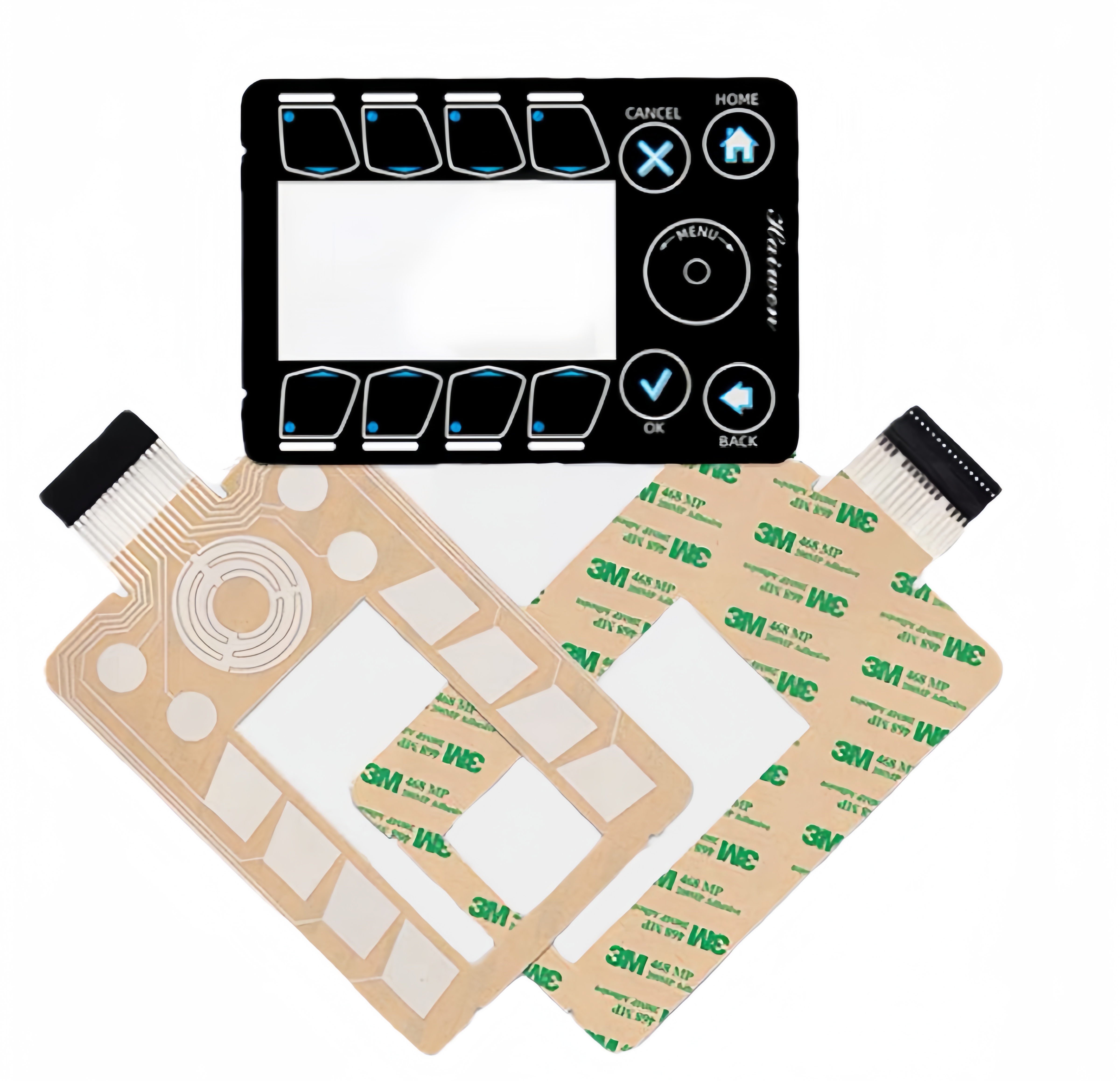

Essential details
MOQ:100
Shipping:Express Delivery
Specification Number:custom design
Product Introduction
Key Features:
Touch Sensitivity: Unlike traditional mechanical switches, capacitive switches respond to touch or proximity rather than physical force.
Sealed Design: They are typically encased in a flexible membrane, making them moisture-resistant and easy to clean.
Durability: Since there are no moving parts, these switches can have a longer lifespan and reduce wear over time.
Aesthetics: Capacitive membrane switches can be designed with various colors and graphics, allowing for customizable and visually appealing interfaces.
Low Power Consumption: They require minimal power to operate, making them suitable for battery-operated devices.
How It Works:
Capacitive Sensing: The switch consists of two conductive layers separated by an insulating layer. When a finger approaches, it alters the capacitance at the sensor location.
Capacitive Sensing: The switch consists of two conductive layers separated by an insulating layer. When a finger approaches, it alters the capacitance at the sensor location.
Signal Processing: This change in capacitance is detected by an integrated circuit, which triggers the desired response (e.g., turning on a light or activating a function).
Applications:
Consumer Electronics: Remote controls, smartphones, and kitchen appliances.
Industrial Equipment: Control panels and machinery interfaces.
Medical Devices: Touch panels on various medical equipment.
Consumer Electronics: Remote controls, smartphones, and kitchen appliances.
Industrial Equipment: Control panels and machinery interfaces.
Medical Devices: Touch panels on various medical equipment.
Advantages:
Enhanced durability and longevity.
Modern and clean design.
Flexible placement and size options.
Considerations:
They may not function well with gloved hands or in very humid environments without proper design considerations.
Sensitivity can be affected by the surrounding environment, requiring careful calibration.

