Major Official Announcement! U.S. Customs Terminates Collection of Reciprocal Tariffs and Fentanyl Tariffs! Effective February 24th
Created on 02.25
On February 23rd, the US Customs and Border Protection (CBP) issued a notice numbered CSMS#67834313, officially confirming that starting from 00:00 Eastern Time on February 24th, all additional ad valorem duties imposed under the "International Emergency Economic Powers Act" (IEEPA) will be terminated.
According to the announcement, all tariff measures implemented under the IEEPA framework will no longer be effective from the effective date.
For imported goods entering consumption or withdrawn from a bonded warehouse for consumption, the relevant additional duties will no longer be levied.
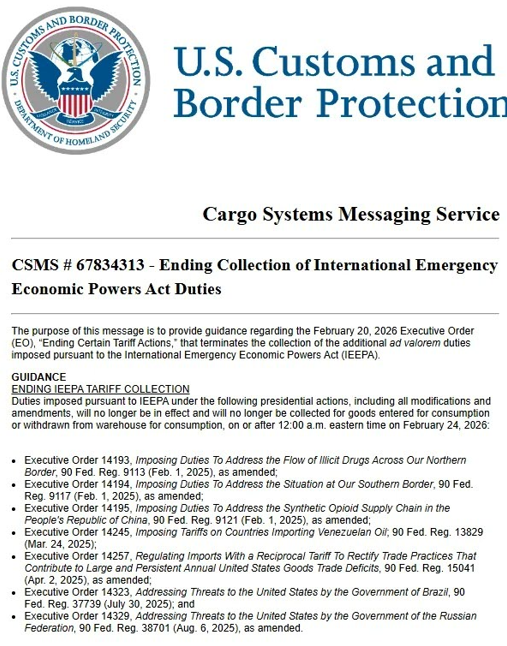
The tariff measures terminated this time cover a wide range, involving tariff collection actions related to seven Presidential Executive Orders.
This includes fentanyl tariffs targeting the so-called Chinese synthetic opioid supply chain, retaliatory tariffs implemented to correct trade deficits, tariff measures covering the inflow of illegal drugs across the US northern border and the situation on the southern border, as well as IEEPA tariffs on countries importing Venezuelan oil, Brazil, and Russia.
To ensure policy implementation, US Customs will simultaneously update the Automated Commercial Environment (ACE) system and deactivate the corresponding IEEPA tariff codes in the "Harmonized Tariff Schedule of the United States" (HTSUS). Starting from February 24th, related taxes will automatically become invalid in the customs declaration system, and businesses will no longer be able to select corresponding IEEPA additional duty codes during declaration.
It should be particularly noted that this suspension of tariff collection only applies to measures under the IEEPA framework and does not affect tariffs imposed by the US under the authorization of other laws.
Tariffs on steel and aluminum for national security purposes stipulated in Section 232 of the "Trade Expansion Act of 1962", and tariffs imposed under Section 301 of the "Trade Act of 1974" for unfair trade practices will continue to be in effect. Tariffs under Section 301 related to new energy vehicles and solar energy, and tariffs under Section 232 related to steel and aluminum are not affected by this adjustment.
For Chinese goods, the additional 20% tariffs previously imposed by the Trump administration (10% retaliatory tariff + 10% fentanyl tariff, with an actual tariff rate during the deferral period) will be reduced to 15% starting from the 24th, marking a phased decrease in export costs for relevant product categories.
It is worth noting that
the termination of these IEEPA tariffs
does not mean that the overall US trade policy is shifting towards easing.
The Trump administration has rapidly introduced a series of alternative tariff measures. On the day of the Supreme Court's ruling, Trump announced a temporary 10% tariff on global goods under Section 122 of the "Trade Act of 1974".
Just one day later, he announced an increase in this "global import tariff" rate to 15%. This measure is valid for 150 days, with exemptions for certain key minerals, pharmaceuticals, agricultural products, and other categories.
The effect of the cancellation of fentanyl tariffs and retaliatory tariffs
may be partially offset by this global temporary tariff.
Not only that, on February 23rd local time, US media reported that the US government is considering imposing a new round of tariffs on approximately six industries, including large batteries, cast iron and iron fittings, plastic pipes, industrial chemicals, and power grid and telecommunications equipment, citing "national security" as the reason. This tariff will be implemented independently of the global 15% tariff measure.
Article Source: Weiyun.net
WeChat