


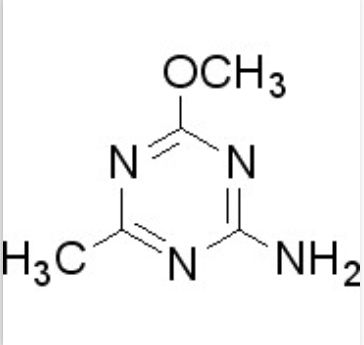

Chemical Property:
| Molecular Formula | C5H8N4O |
| Molar Mass | 140.14 |
| Density | 1.255g/cm3 |
| Melting Point | 258-261℃ |
| Boling Point | 346.4°C at 760 mmHg |
| Flash Point | 163.3°C |
| Vapor Presure | 5.75E-05mmHg at 25°C |
| Appearance | Colorless Crystal |
| Storage Condition | Room Temprature |
| Refractive Index | 1.563 |
| MDL | MFCD00052764 |
| Physical and Chemical Properties | Character: colorless crystal. melting point 86 ℃ boiling point 114 ℃ |
| Use | 2-amino-4-methoxy-6-methyl-1, 3, 5-triazine is an intermediate of sulfonylurea herbicides such as metsulfuron-methyl, chlorsulfuron, thifensulfuron-methyl, ethers and so on, it can also be used for sterilization and anti-corrosion of paper-making coatings, polymer emulsions and metal processing fluids. |
| Hazard Symbols | Xn – Harmful |
| Risk Codes | R22 – Harmful if swallowed R36/37/38 – Irritating to eyes, respiratory system and skin. |
| Safety Description | S26 – In case of contact with eyes, rinse immediately with plenty of water and seek medical advice. S37/39 – Wear suitable gloves and eye/face protection |
2-Amino-4-methoxy-6-methyl-1,3,5-triazine(CAS#1668-54-8)
quality
2-Amino-4-methoxy-6-methyl-1,3,5-triazine is an organic compound. Here are some of the properties of the compound:
1. Appearance: 2-Amino-4-methoxy-6-methyl-1,3,5-triazine is a white to light yellow crystalline solid.
2. Solubility: It is slightly soluble in water and soluble in organic solvents such as methanol, ethanol and methylene chloride.
4. Chemical reaction: The compound is a triazine compound with a zine ring structure containing an amino group and a methoxy functional group. It can be used as a catalyst, ligand, or intermediate in organic synthesis. Depending on its structure, it may undergo common organic reactions like oxidation, reduction, substitution, etc. Uses and synthesis methods
2-Amino-4-methoxy-6-methyl-1,3,5-triazine (AMMT for short) is an organic compound that has a variety of uses.
AMMT can be used as a pesticide intermediate. It can react with other compounds to form the active moiety of the pesticide. For example, by reacting with cypermethrin (Cymoxanil), an effective fungicide can be obtained. AMMT can also react with other heterocyclic compounds to form pesticides such as plant growth regulators and herbicides.
Secondly, AMMT is also used as a synthetic intermediate for photovoltaic materials. Through the functionalization of AMMT, organic molecules with optoelectronic properties can be obtained. These organic molecules can be used in solar cells, light-emitting diodes and other fields, and have good optoelectronic properties.
There are several ways to synthesize AMMT. The most common method is obtained by modifying the functional groups of triazine. One synthesis method is to react 2-amino-4-methoxy-6-methyl-1,3,5-triazine with an appropriate compound under suitable conditions to form a target product. Safety Information
2-Amino-4-methoxy-6-methyl-1,3,5-triazine is a chemical substance, also known as "AMM". Here's its safety information:
1. Toxicity: AMM has relatively low toxicity to humans and has less health effects on humans under normal use conditions.
2. Fire hazard: AMM itself is not flammable, but it can decompose and produce toxic gases when exposed to flames or high temperatures.
3. Storage: AMMs should be stored in a dry, cool place, away from open flames and heat sources. It should be stored separately from other chemicals and avoid mixing.
4. Use: When using AMMs, personal protective equipment such as gloves, goggles, and protective clothing should be used. Avoid direct contact with the skin and eyes, while avoiding inhalation of the substance. After use, wash the area exposed to AMM contact thoroughly.
5. Waste disposal: Follow local regulations and regulations to dispose of waste properly. AMMs must not be discharged into water bodies or sewers.
When handling and using chemical substances, proper handling methods should always be followed and relevant regulations and safety guidelines should be followed.

